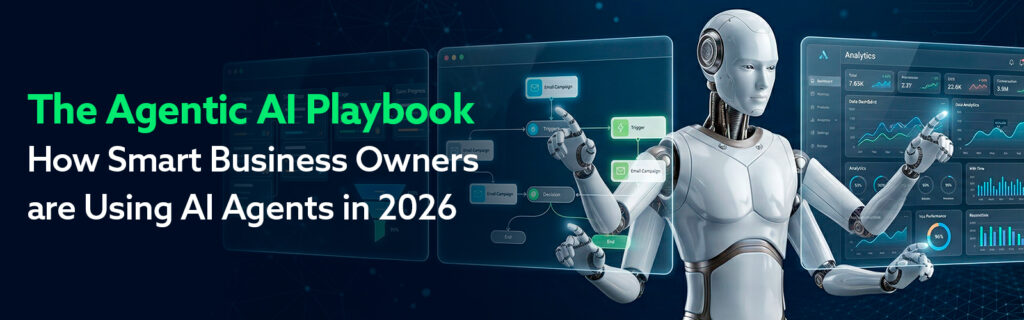
The term ‘agentic AI’ has become overused, but the underlying concept is genuinely important. Traditional AI tools are reactive — they answer when spoken to. Agentic AI is proactive — it pursues a defined goal through multiple steps, adapts to what it finds, and delivers a completed output.
The practical difference: asking ChatGPT to ‘summarise this report’ requires your presence, your upload, and your decision about what to do next. Asking Claude Cowork to ‘compile a weekly competitive intelligence brief from these five competitor websites, format it as a two-page PDF, and save it to the client folder’ requires only your trust — and your review when it’s done.
That shift — from ‘tool you use’ to ‘colleague you delegate to’ — is what makes 2026 a genuinely pivotal year for business AI adoption.
Claude Cowork (Anthropic)
Launched January 2026. A desktop-based AI agent that works within your local file system and integrates with Google Drive, Gmail, and DocuSign. Best for knowledge workers who need AI to handle document-heavy, structured tasks. Included with Claude Pro at $20/month.
Perplexity Computer (Perplexity AI)
Launched February 2026. A cloud-hosted super-agent that orchestrates multiple AI models to execute complex, long-running projects — including building websites, generating research reports, and creating datasets. Best for founders who need diverse output types from a single project brief. Available on Perplexity Max at ~$40–50/month.
Google Pomelli (Google Labs + DeepMind)
Launched October 2025. A free AI marketing agent that reads your brand identity and produces campaigns, social posts, product photography, and video assets autonomously. Best for SMBs needing to scale marketing content without agency budgets. Free at labs.google.com/pomelli.
Anthropic recently introduced the concept of ‘the thinking divide’ — the compounding gap between organisations embedding AI across their people, processes, and products simultaneously, and those treating AI as a point solution or experiment.
The mechanism that makes this gap compounding rather than linear is leverage. A business that uses AI to reclaim 20% of its knowledge workers’ time creates margin. That margin funds further AI investment. That investment creates more margin. Meanwhile, the competing business that is still evaluating tools is falling further behind not arithmetically but geometrically.
Early adoption is rarely about being first. It’s about building workflows, institutional knowledge, and competitive muscle before those things become table stakes.
1. Research and Competitive Intelligence
AI agents can synthesise competitor positioning, industry trends, and market intelligence in minutes. What previously required a junior analyst or an expensive research subscription is now a Perplexity prompt or a Cowork brief.
2. Document and Report Creation
The single largest time sink for most knowledge workers — producing structured documents — is exactly where agentic AI delivers the most dramatic time savings. Proposals, reports, SOPs, client briefs: AI handles the architecture and the first draft.
3. Marketing Content at Scale
Tools like Google Pomelli eliminate the bottleneck between marketing intention and marketing execution. A full month of on-brand social content — posts, images, videos — now takes hours, not weeks.
4. Customer Communication Management
AI agents integrated with email systems can triage, summarise, and draft responses to customer communications in bulk. For businesses managing high-volume customer contact, this is one of the highest-leverage applications of agentic AI.
5. Workflow Automation and Operational Efficiency
Paired with automation platforms like Zapier, AI agents can trigger and complete multi-step operational workflows automatically. New client onboarding, weekly reporting cycles, and recurring administrative tasks are all candidates for AI-driven automation.
What is agentic AI?
Agentic AI refers to AI systems that act autonomously to complete multi-step goals, rather than simply responding to individual prompts. Agentic AI tools like Claude Cowork and Perplexity Computer can plan, execute, and adapt across complex tasks without requiring constant human direction.
What is ‘the thinking divide’ in AI adoption?
The thinking divide is Anthropic’s term for the growing gap between businesses that embed AI agents across their employees, processes, and products simultaneously — compounding productivity advantages over time — and those treating AI as a single point solution. The divide widens exponentially, not linearly.
Which business functions benefit most from agentic AI in 2026?
Knowledge-intensive functions benefit most: research and competitive intelligence, document creation and reporting, marketing content production, and customer communication management. Agentic AI has the highest impact wherever work involves information synthesis and structured output generation.
How do I start with agentic AI without getting overwhelmed?
Start with one use case. Identify your single most time-consuming routine task, choose one agentic tool to address it, and run a 30-day pilot. Measure time saved. Scale what works before adding more tools. The compounding advantage starts from your very first successful workflow.
Are agentic AI tools safe to use for business decisions?
Agentic AI tools are safe when used with appropriate human oversight. The leading tools — including Claude Cowork and Perplexity Computer — are designed with human-in-the-loop checkpoints for irreversible or high-stakes actions. Treat AI output as a well-researched first draft, not a final decision, especially for financial, legal, and client-facing work.